A quintessential 80s Gérald Genta design
Curated Originals: The Cartier Pasha Perpetual Calendar 30003
The 1980s was a decade defined by strong design language, from structured fashion silhouettes to vivid color palettes and expressive forms. The watch world followed suit, producing a wave of timepieces that explored new aesthetics alongside precious materials, high complications, and increasingly ambitious craftsmanship.
4 Minutter

Enter Gérald Genta, who had already made a name for himself by defining the sports watch de luxe of the 1970s with pieces such as the Audemars Piguet Royal Oak and Patek Philippe Nautilus. Cartier tapped the designer to conceive a new watch model for the brand, one that would speak to the tastes of the era while keeping pace with increasingly active, travel-oriented lifestyles.
The result was the modern Pasha. At first glance, it may not look like a traditional sports watch, yet in Cartier’s world, it fulfilled that role while maintaining the Maison’s distinctive design blueprint.
The Origins and Design Language of the Cartier Pasha
The origins of the Cartier Pasha are often traced back to the early 1930s and a request from Thami El Glaoui, the Pasha of Marrakesh. A known patron of Cartier, he is said to have commissioned a wristwatch suitable for both his love of swimming and the demands of royal life. To fulfill the request, Louis Cartier designed an elegant yet water-resistant gold watch with protective elements such as a covered crown and a grid over the dial, features that were highly unusual at the time.
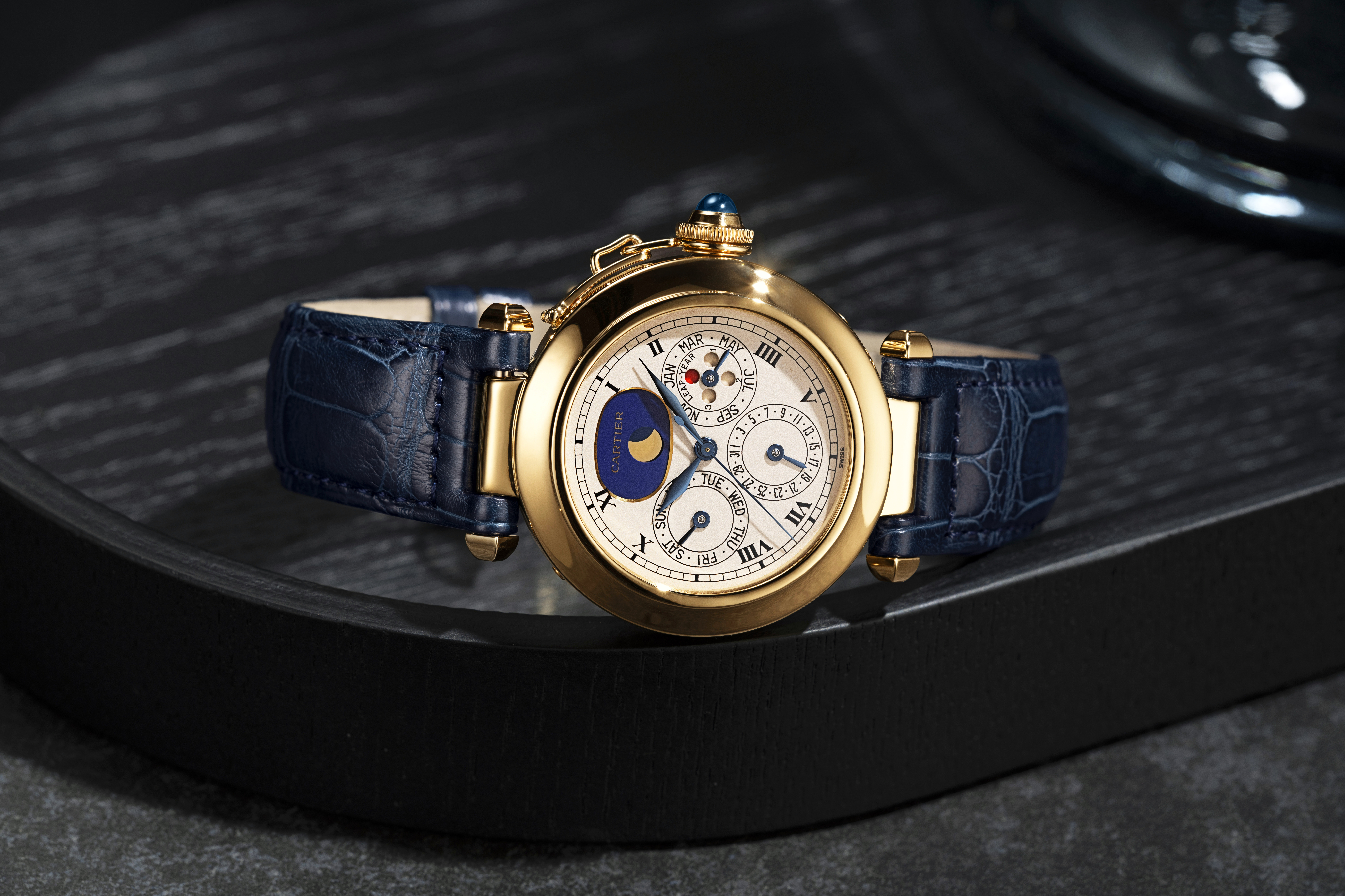
It was this early Cartier water-resistant watch, along with the enduring legend of the Pasha of Marrakesh, that served as inspiration for Genta’s version, which debuted in 1985 as the Cartier Pasha.
Defined by its round case, the design stood apart from Cartier’s more traditional shapes like squares and rectangles, while its 38mm diameter felt notably assertive for the era. Several details quickly became signatures of the model. The screw-down crown cap, set with a sapphire cabochon and secured by a small chain, introduced both a functional and visual focal point.
The dial combined a circular layout with a square minute track at its center, framed by bold Arabic numerals at 12, 3, 6, and 9, creating a distinctive interplay of shapes. Vendôme-style lugs connected the case to the strap, emphasizing the watch’s architectural feel, while the rotating dive bezel, 100 meters of water resistance, and overall construction hinted at sportier intentions.
The Crown Cap
One of the most distinctive features of the Cartier Pasha is its chained crown cap, a design element that is both functional and immediately recognizable. Rather than exposing the winding crown directly, the Pasha conceals it beneath a screw-down cap set with a sapphire cabochon. Once unscrewed, a smaller crown is revealed underneath, used to wind and set the watch.
This “canteen-style” construction draws from earlier approaches to resistance that date back to the 1800s, where enclosing the crown provided an additional layer of protection against dust, sand, and moisture while also shielding it from damage. The attached chain ensures the cap remains secured to the case when opened, preventing it from being lost during use.
While later systems, such as the screw-down crown, would become more widely adopted for water resistance, Cartier retained this tried-and-true solution. In doing so, the Pasha preserves a design that is as practical as it is visually distinctive.

At the same time, the use of gold and Cartier’s unmistakable design codes, such as the cabochon-set crown, railroad minute track, and sword-shaped hands, ensured the Pasha remained firmly within the Maison’s world. This tension between utility and refinement gave the watch a character of its own, setting the foundation for a collection that would go on to accommodate increasingly complex complications, including the perpetual calendar.
The Pasha Perpetual Calendar Ref. 30003
Within the broader Pasha lineup, the reference W3000351 stands out as one of the most technically ambitious executions of the design. Introduced in the late 1980s, it pairs the collection’s unconventional case architecture with a perpetual calendar and moon phase display, bringing high complication into a format that remains distinctly Cartier.
The 38mm 18k yellow gold case retains the defining elements of the Pasha, including its broad bezel, Vendôme lugs, and chained crown cap set with a sapphire cabochon. Here, however, the focus shifts to the dial, where the complexity of the calendar is laid out with notable clarity.
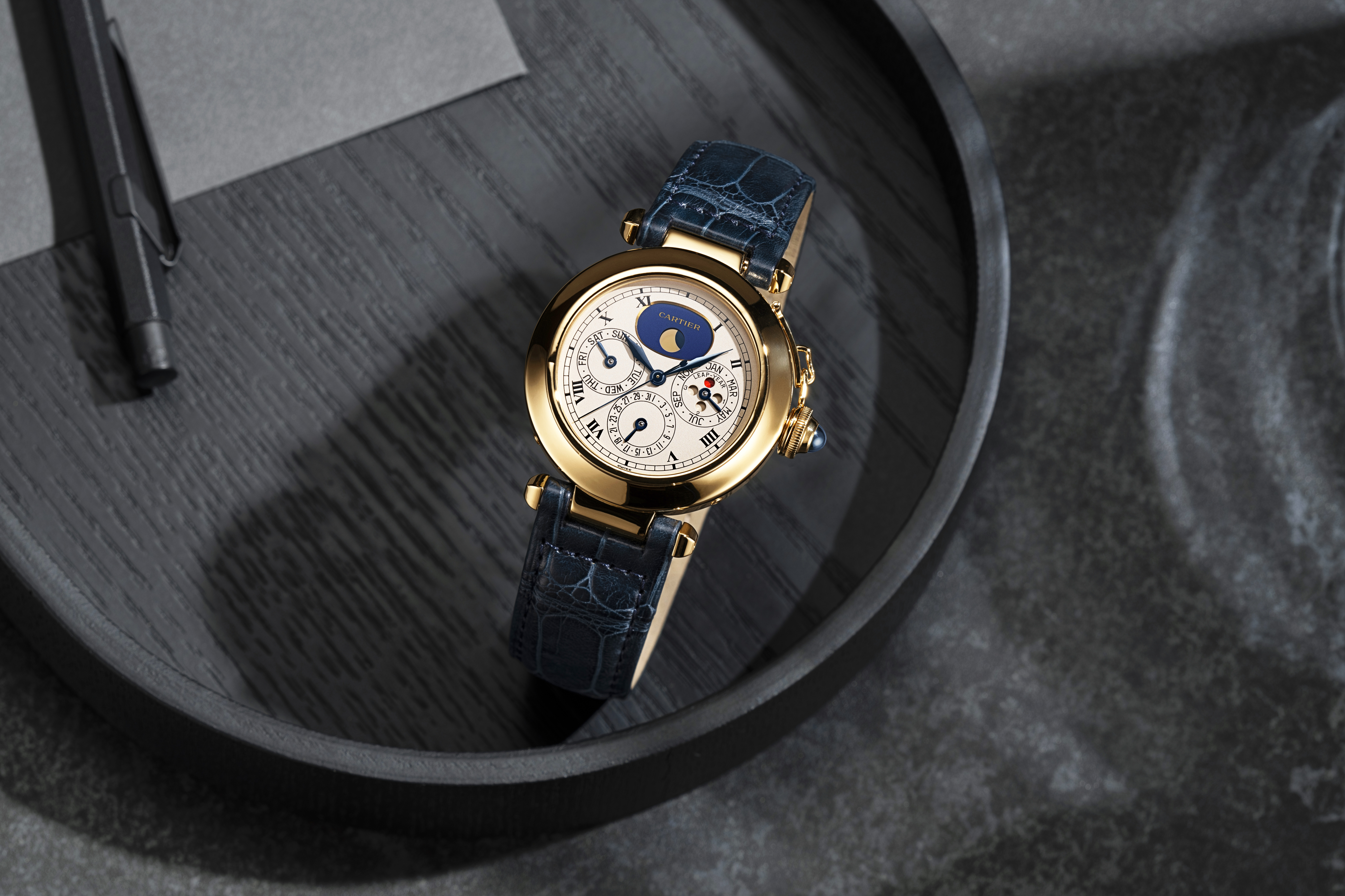
Three subdials display the day, date, and month with leap year indication, while an aperture at 12 o’clock reveals a deep blue moon phase disc. Those familiar with Gérald Genta’s eponymous moon phase watches of the era will recognize the similarity in their scale, style, and presentation.
Unlike some earlier Pasha models, the perpetual calendar reintroduces classic Cartier codes, including Roman numerals and a circular chemin de fer minute track.
In contrast to another Genta-designed perpetual calendar, the Royal Oak Perpetual Calendar, the reference 30003 is powered by a quartz movement. This was a choice that reflects the era in which it was produced. Rather than detracting from the watch, it prioritizes precision and practicality, ensuring the calendar indications remain accurate with minimal intervention. This is particularly relevant for a perpetual calendar, which can be complex to reset once the movement has stopped. In this context, the quartz movement underscores Cartier’s broader focus on combining technical ambition with real-world usability and design.
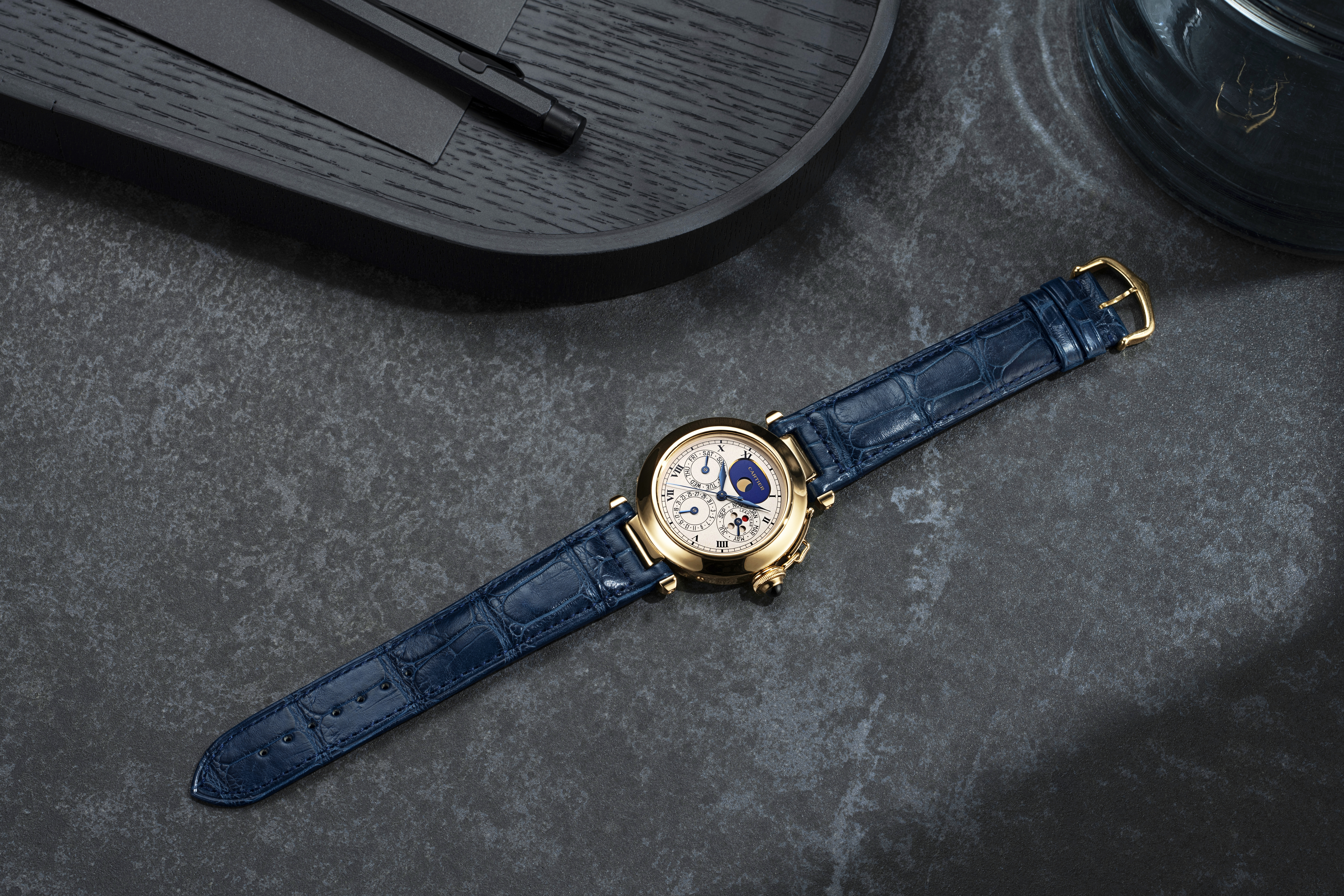
The Pasha Perpetual Calendar ref. 30003 captures a moment when Cartier was willing to experiment with both form and function. By placing a high complication within one of its most unconventional designs, the Maison created a watch that feels both unexpected and entirely coherent. The combination of a quartz perpetual calendar, a distinctive case silhouette, and a dial that balances complexity with clarity gives the reference a character that is difficult to replicate. Decades later, it remains a compelling example of how Cartier approaches complication, not through tradition alone, but through design.